
Every few months someone declares WordPress dead. This time the challenger is serious: AI can write code, design pages, produce content and even assemble entire sites from a single prompt. So it is fair to ask the question out loud — if AI can build a website, do we still need WordPress at all?
We build WordPress plugins for a living and we use AI every single day, so we have skin in this game on both sides. Here is our honest answer: AI is reshaping the WordPress ecosystem from the ground up — but the outcome is WordPress with AI, not AI instead of WordPress. Let us walk through why.
AI is already inside WordPress — officially
This is not a hypothetical future. In February 2026 WordPress.org published its first official AI guidelines, covering plugin development, themes, documentation and media. The five principles are telling: contributors stay accountable for AI-assisted work, meaningful AI help must be disclosed, everything stays GPL-compatible, and quality beats volume — an explicit stance against “AI slop”. The guidelines do not ban AI tools; they normalize them. The project even ships official agent skills and an AI team roadmap, and the guidelines landed in Gutenberg itself in spring 2026.
Read that again: the platform that powers roughly 40% of the web decided that the answer to AI is not resistance, it is integration with accountability. That is the whole story of this post in one sentence.
Do you still need WordPress when AI can generate a site?
Yes — and the reasons are practical, not sentimental.
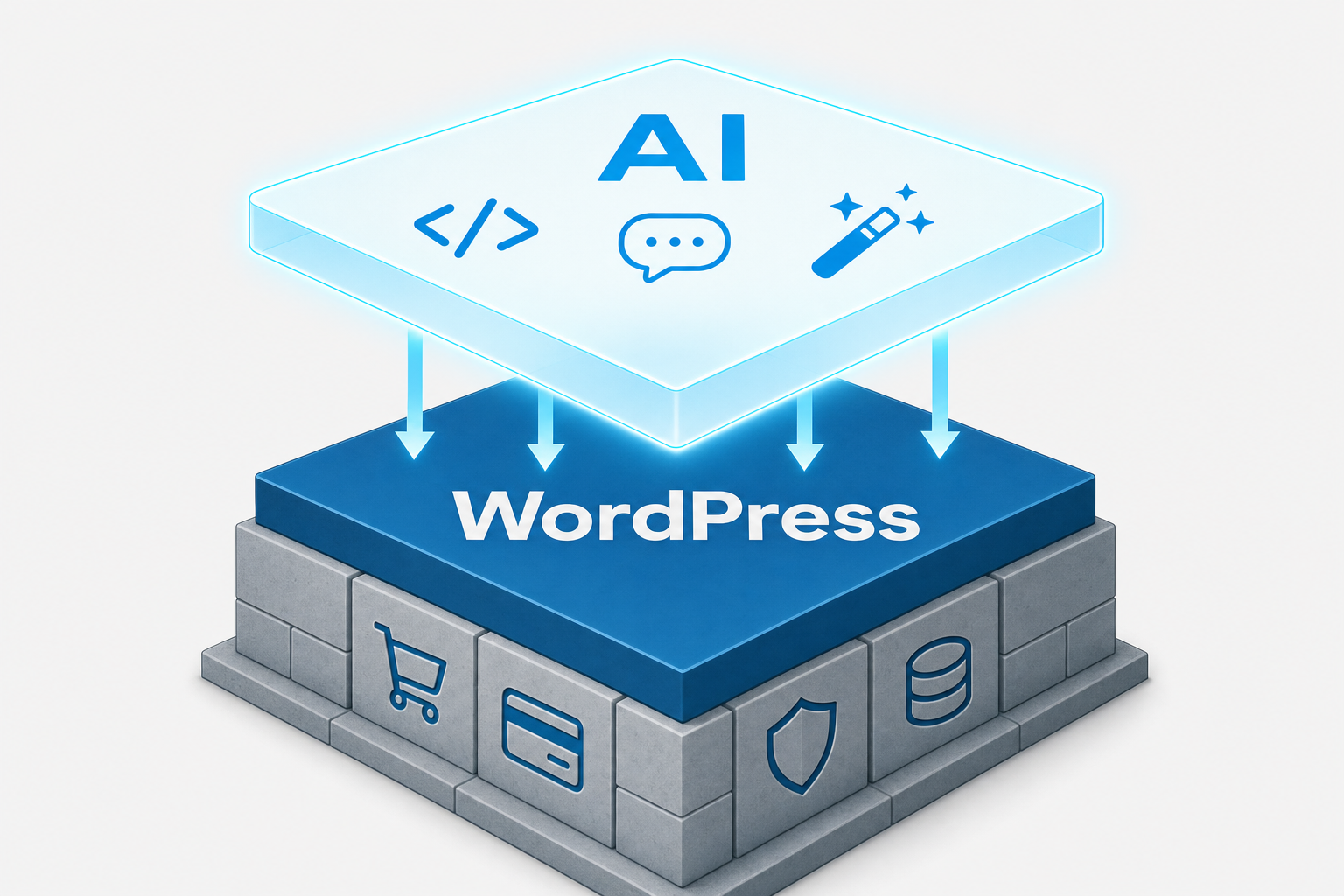
1. A prompt is not a platform. An AI can generate a site, but the generated thing still has to run somewhere: it needs hosting, updates, backups, a database, user management, caching. WordPress is that boring, reliable layer. Skipping it does not remove the problem, it just means the AI has to reinvent it — badly, and differently every time.
2. Payments and integrations are trust infrastructure. Would you point a card checkout at code an AI hallucinated last Tuesday? WooCommerce, Stripe and PayPal integrations, subscription billing, invoicing, tax handling — these are battle-tested by millions of stores and audited for edge cases an AI has never seen. When money moves, “mostly correct” is not a category. This is exactly where mature plugins earn their keep, and it is why AI is not replacing WordPress plugins — it is being packaged into them.
Let us be precise about where the gap actually is, because it is not in the coding. Ask an AI to build a payment gateway from the Stripe documentation and it will happily produce one — the API docs are public, the happy path is well-trodden, and the code will look complete. The problem is everything the documentation does not say:
- Webhook idempotency. Stripe retries failed webhooks. If your handler is not idempotent, a network hiccup means a customer charged twice or a subscription activated twice. The docs mention it in passing; production teaches it brutally.
- SCA and 3D Secure flows. European Strong Customer Authentication turns a one-step charge into a multi-step dance with exemptions, fallbacks and abandoned-authentication states. An AI codes the flow it was asked for; a payments developer codes the flows the regulation forces on you.
- Refunds, partial refunds and chargebacks each mutate order state differently, interact with inventory and invoicing differently, and have different legal consequences. The happy path is maybe a fifth of a real gateway.
- Currency edge cases — zero-decimal currencies, rounding rules on tax-inclusive prices, multi-currency refund rates. Nobody prompts for these, because nobody remembers them until they bite.
Invoicing is even starker, because the hard part is not logic — it is law. Invoice numbers must be strictly sequential in most of Europe, and a gap can trigger an audit. VAT rates depend on customer country, product type and thresholds under the EU OSS scheme. Several countries require real-time invoice reporting to the tax authority — Hungary’s NAV, Italy’s SdI, Spain’s SII — each with its own XML schema, signing rules and deadlines. Retention periods differ per country. An AI will generate a beautiful PDF invoice from a prompt; it will not tell you that the numbering scheme it invented is illegal in your market, because the legal and logical challenges never surface in the documentation it learned from. They surface in audits, fines and support tickets — the training data that mature plugin vendors have and a fresh prompt does not.
3. Deterministic beats generative — for the boring 95%. Here is the future-proofing argument almost everyone misses: on a WordPress site, you do not need AI to change anything. Want a different menu, a new payment method, an edited paragraph? You click, you edit, you save — the same action produces the same result every time, forever, with no tokens burned and no model in the loop. A site that can only be modified by re-prompting a model is a site you rent from that model. A WordPress site is one you own: the code, the content and the data are yours, exportable and GPL-licensed.
4. Testing needs a stable target. Staging environments, plugin update flows, backup-and-restore drills, Core Web Vitals monitoring — the entire discipline of running a site safely assumes a predictable platform underneath. You can test WordPress. You cannot meaningfully regression-test a site that is regenerated from scratch on every change.
And yes, AI helps with testing too — it will draft unit tests, generate fixtures, even suggest edge cases. But be honest about what that is: a test the AI writes proves the code does what the code does. Proper development testing proves the software does what the business and the law require, and that is a different activity entirely: running against the gateway’s sandbox with real 3DS challenge flows, simulating a failed subscription renewal on the 3rd retry, checking what happens when two plugins hook the same order status transition, load-testing checkout before a sale weekend, re-running the whole matrix after every WooCommerce update. That workflow needs a stable platform to test against and an experienced human deciding what is worth testing. AI-assisted testing inside a real development process is a force multiplier; AI-generated tests instead of a development process is a false sense of security.
And the developers? Still needed — more than you would think
The numbers say AI-assisted development is now the default: industry surveys report that around 84% of developers use AI tools, and roughly 41% of new code is AI-written. So is the WordPress developer obsolete? The research says the opposite — with a twist.
The most sobering data point comes from METR, which ran controlled trials on experienced developers: in the original 2025 study they were measurably slower with AI while being convinced they were faster. The 2026 follow-up shows the gap closing as tools and — crucially — working habits improve. The lesson is not “AI does not work”. The lesson is that AI is a multiplier, and a multiplier needs something to multiply.
That something is experience. Using AI well is a genuine mindset shift, not a shortcut:
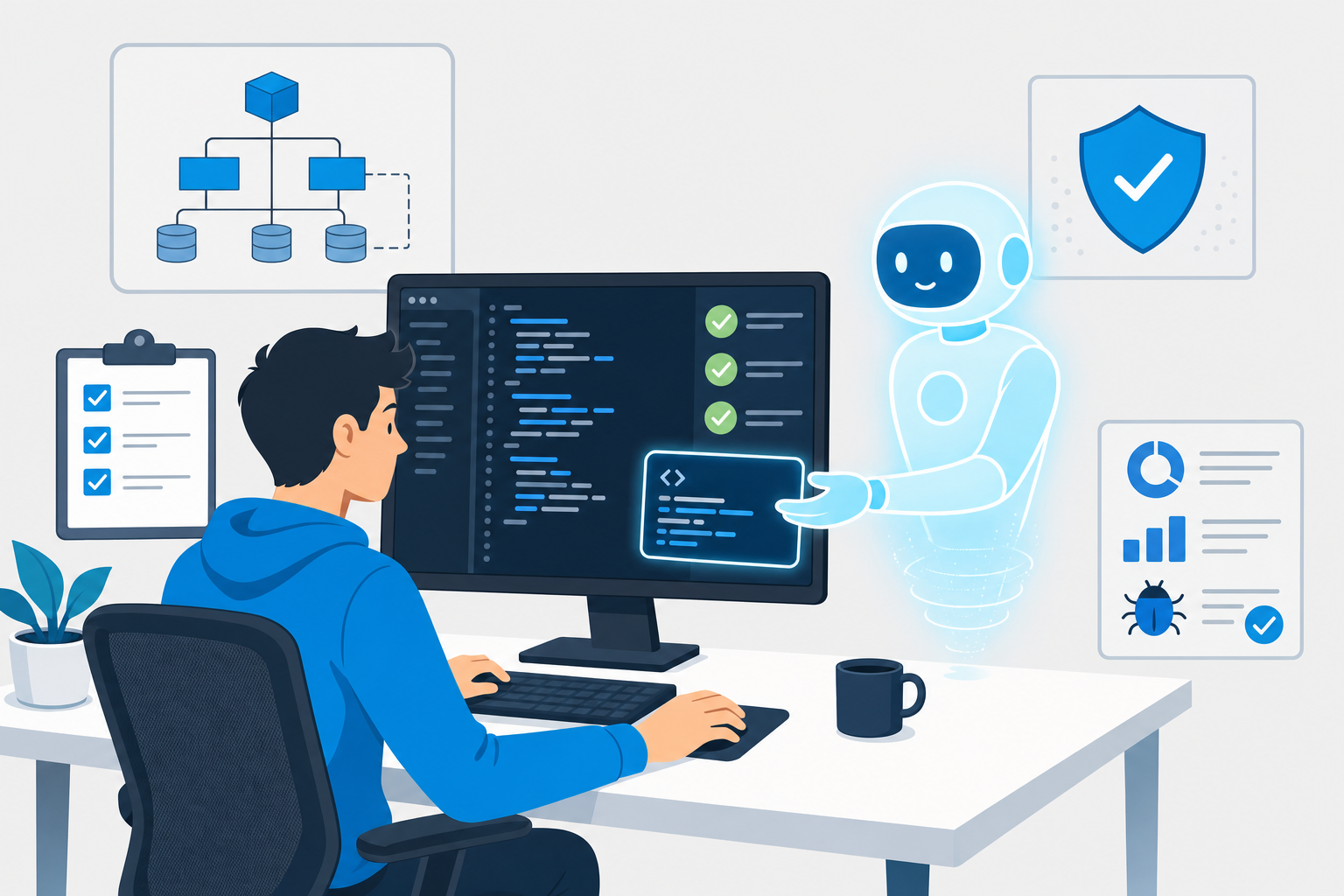
- Someone has to review the code. AI output looks confident whether it is right or wrong. Knowing where it tends to be wrong — nonces, capability checks, SQL escaping, hook timing — is exactly what senior WordPress experience is.
- Someone has to test it. “It ran once in a demo” and “it survives a WooCommerce sale weekend” are different universes. Staging discipline, rollback plans and monitoring do not come from a prompt.
- Someone has to decide what to build. Scoping, architecture, saying “no, that plugin combination will bite us in a year” — judgment is the part of the job AI amplifies rather than replaces.
What this means if you own a WordPress site
For site owners, the AI era is mostly good news, and it arrives through the ecosystem you already use. The 2026 trend line is clear: AI features are showing up inside WordPress products — smarter search, automated alt text, anomaly detection in analytics, AI-assisted support — rather than as a replacement for them. Concretely:
- Development gets cheaper. A customization that took a developer three days now takes one. You pay for the judgment and the testing, not the typing.
- Fewer bugs reach production. AI-assisted review and test generation catch entire classes of mistakes before deploy — when a developer runs that process.
- Maintenance stops being scary. Update diffs, error logs and performance regressions are exactly the tedious, high-volume work AI triages brilliantly.
The conclusion: WordPress with AI
AI is fundamentally reshaping the WordPress ecosystem — how plugins are written, how content is produced, how sites are maintained, even how the project governs contributions. But the direction is unmistakable: WordPress with AI, not AI instead of WordPress. The platform provides what generative tools structurally cannot: determinism, ownership, tested payment rails and a 20-year ecosystem of solved problems.
The same goes for the people. The WordPress developer of 2026 is not being replaced; they are being upgraded — shipping faster, catching more bugs before production, and costing less per delivered feature, precisely because their experience is what turns AI output into something you can trust. The winners of this era will not be the ones who avoided AI, nor the ones who outsourced their judgment to it. They will be the ones who put AI to work on top of a platform — and a skill set — that was worth keeping.


