
Every week we go through the WordPress vulnerabilities that received a CVE the week before and sort out which ones deserve your attention first. This report covers November 16 to 22, 2026.
The short version: start with WordPress itself. WordPress 7.1.5 came out on Wednesday with 20 security fixes, among them a bug that could lead to code execution without a login. Most sites installed it on their own, but check that yours did. Five bugs this week carry Patchstack’s “known to be exploited” badge, and the most serious is in the Soledad theme (60,000+ sales): code execution without login until 8.7.8. UpdraftPlus (4,000,000+ installs) fixed eight bugs that wait in the database until someone restores a backup, so update it before your next restore or migration. And three versions we recommended recently are already out of date: Forminator needs 1.58.6, Everest Forms 3.6.5 and NextGEN Gallery 4.6.0.
The week in numbers
514 new CVEs were published for WordPress plugins and themes last week, up from 446 the week before. It is the fourth-biggest week of 2026. The median since January 2024 is 196 a week, and 263 in 2026.
- Severity: 18 critical, 174 high, 271 medium and 6 low (CVSS 3.1 base score from the record). 45 records from WPScan have no score yet. 17 of the 18 critical ones need no login.
- Affected: 341 components, 508 records for plugins and 6 for themes. No WordPress core record yet: the 7.1.5 fixes have no CVE numbers in the list so far.
- Bug types: cross-site scripting leads with 226 records (44%), followed by broken access control (128), information disclosure (36), SQL injection (19) and privilege escalation (18).
- Login: 296 of the 514 records need no account at all.
- Sources: Wordfence 216, Patchstack 205, WPScan 77, VulnCheck 14, others 2.
- Fixes: of the 466 records for plugins hosted on WordPress.org, 444 already have a newer release than the last affected version and 20 belong to plugins that WordPress.org has closed. The other two (UpdraftPlus and WP STAGING) are fixed too, our database just didn’t have the version yet. 48 records are for premium plugins and themes, or for components our database couldn’t match to WordPress.org.
- No fix: 7 of the 18 critical records came without a fixed version. Three of them turned out to be fixed after all, one is unconfirmed, and three are in plugins that WordPress.org has closed. More on those further down.
Every record, with search and filters, is in our WordPress vulnerability database, which updates daily from the CVE List.
How we rank them
The CVSS score is a starting point, not the answer. We look at who can reach the bug, what has to be switched on for it to work, what the attacker gets and how many sites run the plugin. None of this changes what to do: every fix below should go in as soon as you can. The ranking tells you where to start, and which sites to look at more closely if they ran an old version for a while.
- Highest risk: anyone can reach the bug, the impact is serious and nothing special has to be switched on, or it is already being exploited.
- High risk: it takes an account, an admin action or an unusual trigger, or the impact is narrower.
- Depends on your setup: only exploitable with a specific option, add-on or site type. If your site matches, treat it as highest risk.
This week shows how much the date on a CVE can mislead. GiveWP’s account takeover, the WP STAGING object injection, the WP Import Export Lite code execution and the Advanced Custom Fields data leak all got their CVE last week, but the fixes are from September, October and even March. Sites that update regularly were never exposed. UpdraftPlus is the opposite case: its fix came out the same day as the first CVE, and the bugs it closes sit quietly in the database until the day you need your backup.
This week’s shortlist
Update everything on this list now. The groups only show where the risk is highest, so you know where to start.
| Plugin | Bug | Login needed | Fixed in |
|---|---|---|---|
| WordPress coreevery site | 20 security fixesone could lead to code execution | Nofor several of them | 7.1.5or 7.0.9, 6.9.12 and older branches |
| Soledad themePremium, 60,000+ sales | Code executionexploited | Nobuilt with Elementor | 8.7.8 |
| rtMedia7,000+ installs | SQL injectionexploited | No | 4.7.184.7.19 is current |
| Simple Shopping Cart10,000+ installs | PHP object injectionexploited | No | 5.3.4 |
| Dokan30,000+ installs | Paid download links readableexploited | No | 5.3.45.3.5 fixes two more |
| WP DuplicateClosed on WordPress.org | Code execution and file readexploited | No | No fixremove it |
| UpdraftPlus4,000,000+ installs | SQL injection on restore8 records | Subscriberruns when an admin restores or migrates | 1.26.16Premium 2.26.16.26 |
| Elementor10,000,000+ installs | Cross-site scripting | Noone click from an admin | 4.4.14.3.6 is not enough |
| Forminator600,000+ installs | Stored cross-site scriptingtwo ways in | Norich-text drafts or default upload types | 1.58.5go to 1.58.6 |
| GiveWP100,000+ installs | Donor account takeover | NoEmail Access on, the default | 4.18.04.19.2.1 is current |
| WP STAGING100,000+ installs | Object injection to code executionfixed in October | Subscriber | 4.18.0Pro 6.18.0 |
| Hide My WP Ghost100,000+ installs | Two-factor bypassand 2 more | Password knownXML-RPC not disabled | 7.0.19go to 7.0.20 |
| Germanized for WooCommerce70,000+ installs | Stored cross-site scriptingthrough a billing name | No | 4.1.9 |
| miniOrange OTP Verification5,000+ installs | Login without the one-time codeexploited | NoOTP on the login form | 5.6.2go to 5.6.3 |
| Yoast SEO10,000,000+ installs | Private posts readable | NoREST API endpoint on, the default | 28.9 |
| WPvivid Backup900,000+ installs | File deletionand object injection | Noa migration key generated | 0.9.135go to 0.9.140 |
| WP Fastest Cache1,000,000+ installs | Folder deletion | NoCustom Permalinks or GeoDirectory | 1.5.5 |
| Shortcodes Ultimate400,000+ installs | File inclusionand 5 more | Noa QR code of the current URL | 7.9.2go to 7.9.3 |
| Everest Forms90,000+ installs | Plugin activation, file deletion4 records | Delegated roleform access given to other roles | 3.6.53.6.4 is not enough |
| Masteriyo LMS6,000+ installs | PHP object injection | Noinstructor sign-up and guest checkout | 3.5.2 |
| WPO365 and Authorizer10,000+ and 7,000+ | Login as another user | NoSAML, OIDC or OAuth2 login | 45.4 and 3.17.2Authorizer 3.17.3 is current |
| Nexter Blocks ProPremium | New administrator account | NoLogin & Register block on a page | Not confirmedupdate to the newest build |
| Burst Statistics200,000+ installs | Other plugins switched off per request | No | 3.7.5same as last week |
| Kadence theme and two dozen plugins500,000+ for Kadence | Stored cross-site scriptingthrough comments | Noopen comments | VariousKadence 1.6.0.1 |
Highest risk
Bugs that anyone can reach, or that are already being exploited. Start here.
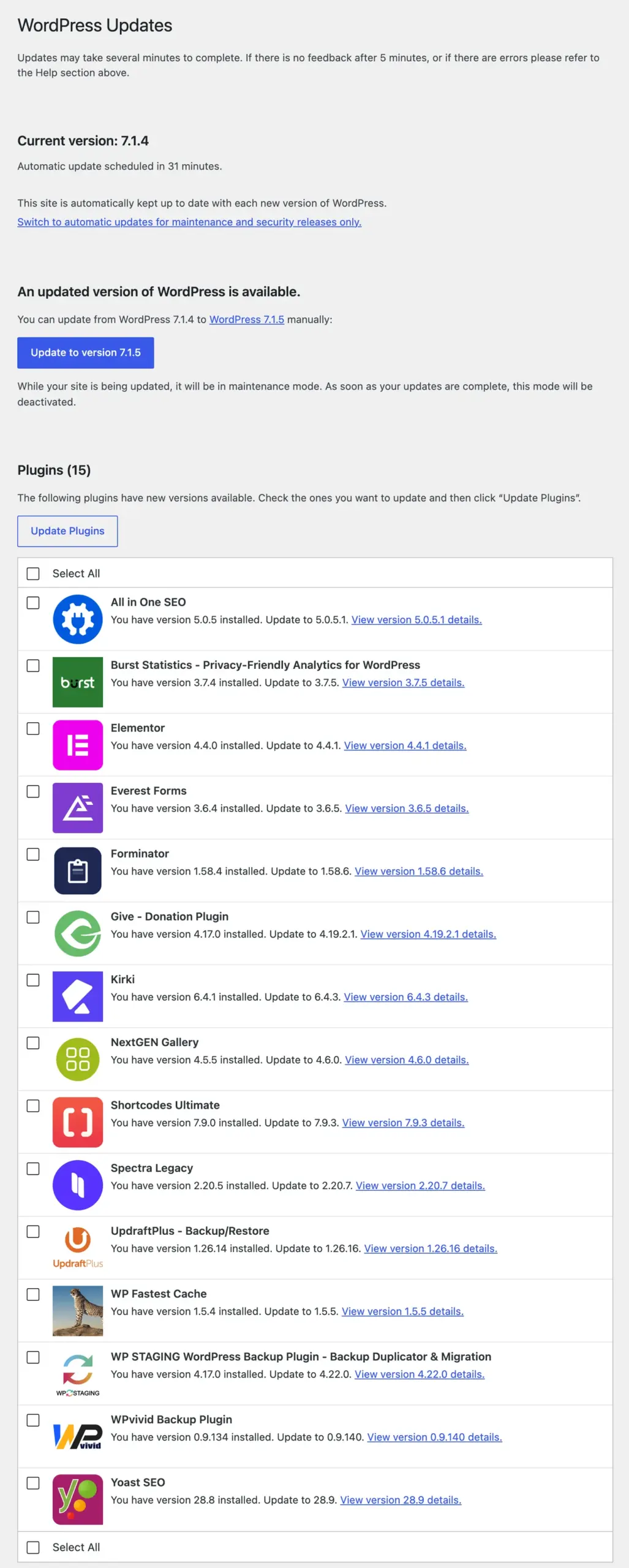
WordPress 7.1.4 and older: twenty fixes in one release
WordPress 7.1.5 came out on Wednesday, November 18, as a security release. The release announcement lists 20 issues. The ones that matter most for a typical site:
- an unauthenticated privilege escalation through Template Part block attributes that, according to the release notes, could lead to remote code execution;
- a stored script through shortcode attributes in comments, also without login. The fix is in the shortcode parser itself, so it protects every plugin that runs shortcodes;
- two SQL injections, one in the meta query code that plugins use to filter posts, one through the front page setting in Customizer previews;
- private taxonomy terms readable through the REST API search, and a denial of service through batched XML-RPC pingbacks, both without login;
- on multisite, a site Administrator could take over a Super Admin account through Customizer menu previews.
The rest are mostly scripts that need an account or a click, smaller leaks for logged-in users, an authorization bypass for Authors when editing comments, and two hardening changes. WordPress installs security releases automatically unless someone switched that off, so most sites are on 7.1.5 already. Check Dashboard → Updates anyway: some managed hosts and maintenance setups turn automatic updates off and roll them out on their own schedule. Sites on older branches got the fixes as 7.0.9, 6.9.12 and so on, all the way back to 4.7.40. None of these issues has a CVE number yet; we’ll count them when they get one.
Update now. Make sure the Updates screen says 7.1.5, or the latest release of your branch. WordPress 7.2 is planned for December 8.
Soledad theme 8.7.7 and older: code execution without login, already exploited
Patchstack: known to be exploited · 60,000+ sales · CVE-2026-121684
Soledad is one of the best-selling blog and magazine themes on ThemeForest. Anyone could send a request to its public “load more posts” handler and make the theme include a file of their choosing, which ends in code running on the server. The chain goes through Elementor, so sites built with Elementor are the ones exposed; sites built only with WPBakery are probably not reachable this way, but we could not confirm that. Patchstack marks the bug as exploited. It is the fourth Soledad bug with that badge.
The fix is in 8.7.8 from October 30. Its changelog says only “Addressed all identified security issues”, and as a premium theme we can’t read the code, so we take the vendor’s word for it. Theme updates come through your Envato licence or the Penci dashboard, not from WordPress.org. Copies without a licence don’t get them.
Update now to 8.7.8. If the site ran 8.7.7 or older into November, check for administrator accounts you don’t know and PHP files in places where only uploads belong.
rtMedia 4.7.17 and older: SQL injection without login
Patchstack: known to be exploited · 7,000+ installs · CVE-2026-128102
rtMedia adds media galleries to BuddyPress and bbPress communities. A parameter for custom fields went into a database query without proper escaping, so any visitor could add their own SQL and read data out of the database: user emails, password hashes, anything else stored there. Patchstack marks it as exploited. Fixed in 4.7.18 on November 17. 4.7.19, out two days later, also fixes a stored script that members could add through media titles.
Update now to 4.7.19. If the site ran an older version, assume the user table has been read: have administrators change their passwords.
Simple Shopping Cart 5.3.3 and older: object injection through the cart
Patchstack: known to be exploited · 10,000+ installs · CVE-2026-131782
The plugin saved each visitor’s cart as serialized PHP. Characters a visitor typed into cart fields could shift that saved data, and the cart was read back without limiting which classes it could create, so a visitor could make the site build objects of any class it has loaded. On its own the plugin contains nothing that turns this into code execution, but other plugins on the same site often do, and Patchstack marks the bug as exploited. 5.3.4 from November 20 only accepts the plugin’s own cart classes.
Update now to 5.3.4.
Dokan 5.0.15 to 5.3.3: paid download links for anyone
Patchstack: known to be exploited · 30,000+ installs · CVE-2026-119220
Dokan turns WooCommerce into a multivendor marketplace. A check meant for its new AI integration matched a marker anywhere in the request address, and when it matched, WooCommerce’s product API answered as if the visitor were allowed to edit products. Anyone could read the full record of every published product, including private notes, hidden products and the download links of paid digital products. No AI or MCP setting has to be on; the code arrived in 5.0.15 in August. Fixed in 5.3.4 on November 5. 5.3.5 from November 19 fixes two more bugs that need a customer or vendor account.
Update now to 5.3.5. Marketplaces that sell downloads should consider their file links public and replace the ones that matter.
High risk
These need an account, an admin action or a specific trigger, or the impact is narrower. Update them right after the ones above.
UpdraftPlus 1.26.15 and older: a trap that waits for your restore
4,000,000+ installs · CVE-2026-108761, 111067 and 121150 to 121155
Eight records, one theme. A user with the lowest account level, a Subscriber, could put specially crafted text into the database, for example in their own profile’s biographical info. Nothing happens until an administrator restores a database backup, migrates the site to a new address, or runs the plugin’s search and replace tool. Then the restore code misreads that text and runs it as SQL, which can make the attacker an administrator. One of the eight needs no account at all: text from a comment that only becomes a script after the site is moved.
All of this applies to the free plugin too, since it has its own restore, migration and search and replace features. Fixed in 1.26.16 on November 18, and in Premium 2.26.16.26. There was never a 1.26.15 on WordPress.org. By our reading of the code, one of the bugs is written into the backup file itself when large tables are exported, so after updating we would make a fresh backup and use that one first.
Update now to 1.26.16 before your next restore or migration. After any restore done on an older version on a site with open registration or customer accounts, look through Users for administrators you don’t know.
Elementor 4.4.0 and older: one click from an administrator
10,000,000+ installs · CVE-2026-109878
A cross-site scripting bug that needs no account, only an administrator who clicks a prepared link. Script running in an administrator’s session can do anything that administrator can. It was reported in August and fixed in 4.4.1 on November 16, so the 4.3.6 we recommended four weeks ago is no longer enough. Another Elementor record published this week is old news: before 4.0.6 from May, a Contributor could read every user’s email and password hash (CVE-2026-2307).
Update now to 4.4.1.
Forminator 1.58.4 and older: last week’s version is this week’s bug
600,000+ installs · CVE-2026-119632, 120676 and 131721
Last week we sent you to 1.58.4. That is the last vulnerable version. Two of the new bugs let visitors store a script. In the first, a form with a rich-text Textarea and Save and Continue switched on accepted a draft with script in it, which ran when someone resumed the draft or opened it from the Submissions screen. In the second, an upload field left at the default file types accepted .rtx files, and on many Apache servers the browser opens those as web pages. Wordfence calls it an incomplete fix of a 2024 bug.
Both are fixed in 1.58.5, which only reached WordPress.org on November 17. 1.58.6 came six minutes later with more checks on rich text, so that is the one to have.
Update now to 1.58.6. If you use upload fields, look for .rtx files under wp-content/uploads/forminator/.
GiveWP 4.17.0 and older: a donor account taken over by email address
100,000+ installs · CVE-2026-82675
With Email Access on, donors can open their donation history through a link sent to their email address. A visitor who knew a donor’s address could get hold of that access and set a new password for the WordPress account linked to the donor. If an administrator ever donated while logged in, for example to test the form, that administrator account was linked too. Email Access is switched on when GiveWP is freshly installed.
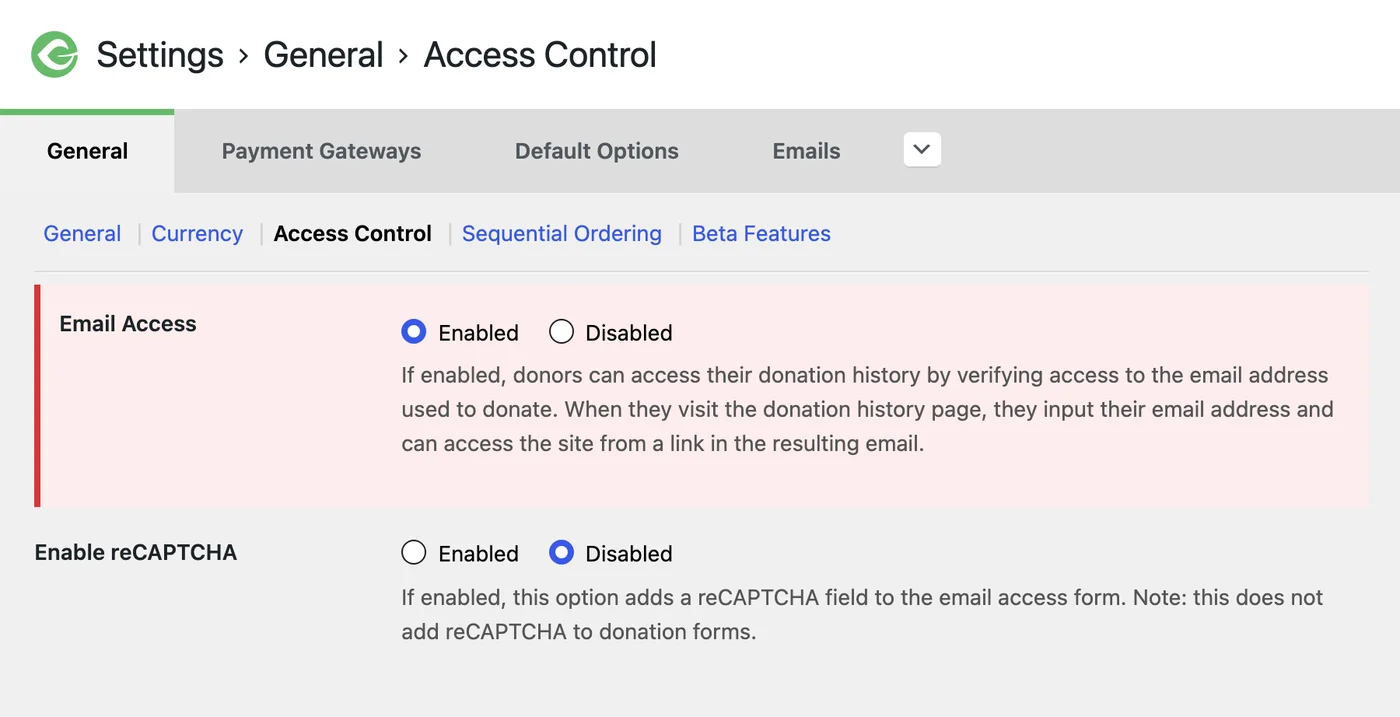
The fix is in 4.18.0 from October 1, seven weeks before the CVE. Careful with the changelog: the entry for 4.16.8 already names this CVE, but 4.16.8 and 4.17.0 are still vulnerable. The current 4.19.2.1 from November 17 also fixes five smaller GiveWP records published this week.
Update now to 4.19.2.1. If the site ran 4.17.0 or older with Email Access on, check for password resets on accounts that are linked to donors.
WP STAGING 4.17.0 and older: an old fix with a new number
100,000+ installs · CVE-2026-109555
A Subscriber could plant data that the plugin later turned into PHP objects, and Wordfence describes a path from there to code execution. Our database had no fixed version for it, because the fix is a month older than the CVE: WP STAGING 4.18.0 and Pro 6.18.0, both from October 18. The fix is on the restore side, so once you are updated, restoring an older backup is safe.
Update now to 4.22.0 (free) or the current Pro.
Hide My WP Ghost 7.0.18 and older: the second factor didn’t cover XML-RPC
100,000+ installs · CVE-2026-126040, 126039 and 126041
Someone who already had a user’s password could log in through XML-RPC without the plugin’s two-factor code, as long as the plugin’s own “Disable XML-RPC Access” option was off. Two smaller bugs came with it: a stored script through a comment author name, and a debug branch that revealed the hidden login address the plugin exists to hide. Fixed in 7.0.19 on November 12. One catch: the vendor changed the 7.0.18 release after it was published, so a site that installed 7.0.18 between November 9 and 11 shows 7.0.18 and still has the old code. It is the second time in two months this plugin has done that.
Update now to 7.0.20.
Germanized for WooCommerce 4.1.8 and older: a script in a billing name
70,000+ installs · CVE-2026-131609
The withdrawal button feature, part of every Germanized release since 4.0.4, has no off switch. On shops that allow guest checkout, a visitor could place an order with a script in the billing first name, then file a withdrawal request for it. The script ran when shop staff opened WooCommerce → Withdrawals. Fixed in 4.1.9, one day after the report.
Update now to 4.1.9.
Depends on your setup
These only work with a specific option, add-on or site type. Update them anyway. The condition tells you whether a site that ran an old version needs a closer look.
miniOrange OTP Verification and miniOrange 2FA: one-time codes that could be skipped
Patchstack: known to be exploited (OTP Verification) · 5,000+ and 10,000+ installs · CVE-2026-129073 and 129074
On sites that ask for a one-time code on the WordPress login form, OTP Verification 5.6.1 and older could be logged into without it. Patchstack marks this one as exploited. Fixed in 5.6.2 on November 16; 5.6.3 is current. Its sister plugin, miniOrange 2FA 6.6.0 and older, let any user who got to the two-factor step of the login delete settings from the site’s options table, fixed in 6.6.1. The 6.3.1 we recommended in October is no longer enough.
Update now to 5.6.3 and 6.7.0.
Yoast SEO 28.8 and older: private posts through the REST API
10,000,000+ installs · CVE-2026-120413
Yoast has a REST endpoint that returns the SEO data for any address, made for headless sites. It didn’t check whether the visitor was allowed to read the post, so anyone who knew or guessed the address of a private or draft post could get its title, author, date and excerpt. The endpoint is on by default. It is only a leak, but it matters for sites that keep announcements, member content or internal pages in private posts.
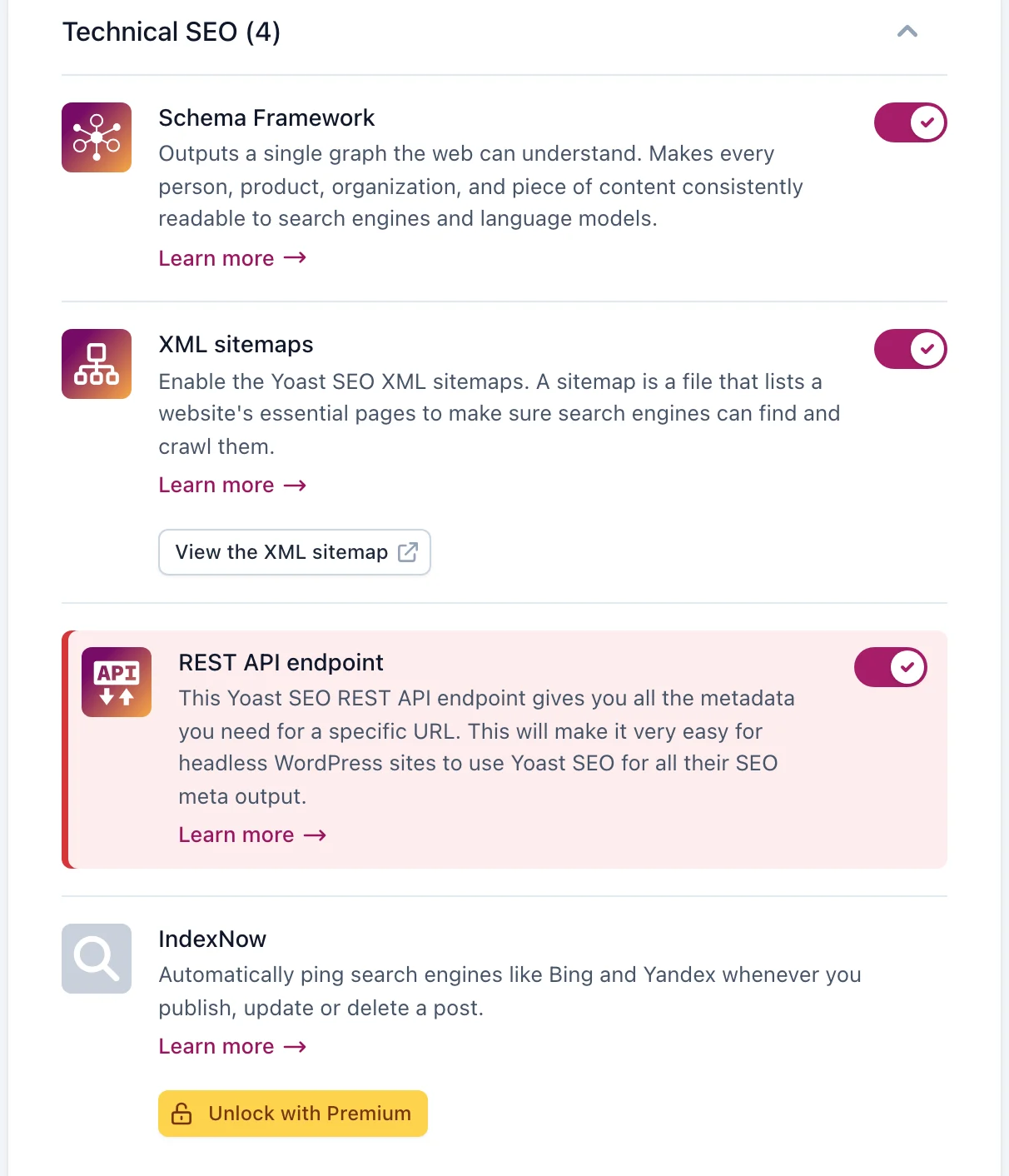
Update now to 28.9. Fixed on November 18.
WPvivid Backup 0.9.134 and older: a migration key that let visitors delete files
900,000+ installs · CVE-2026-84693, 120390 and 120391
To receive a backup from another site, WPvivid generates a key on its Key tab that stays valid for 8 hours by default. While such a key was valid, anyone could plant a record that made the next backup run delete files of their choosing. Fixed in 0.9.135 in September. Two newer records, object injection for Subscribers that fires when an administrator restores a database, are fixed in 0.9.140.
Update now to 0.9.140.
WP Fastest Cache 1.5.4 and older: a permalink that deletes folders
1,000,000+ installs · CVE-2026-119114
A crafted address could make the cache cleanup delete folders outside the cache. The way in needs the Custom Permalinks plugin or GeoDirectory on the same site. Fixed in 1.5.5 on November 5.
Update now to 1.5.5.
Shortcodes Ultimate 7.9.1 and older: a QR code of the current address
400,000+ installs · CVE-2026-104904 and five more
A page with a QR code shortcode set to the current page address, together with a server that accepts a forged Host header, let a visitor include files from the server. Fixed in 7.9.2 in October. The five other records, for Contributors, were fixed in 7.9.1 in September, and 7.9.3 adds four more fixes.
Update now to 7.9.3.
Everest Forms 3.6.4 and older: the fourth security release in a row
90,000+ installs · CVE-2026-129220, 129024, 131750 and 129066
Last week we said 3.6.4. All four new records are fixed in 3.6.5 from November 19. The most serious one needs a setup where an administrator gave form access to other roles under Tools → Roles and Permission: those users could then activate any installed plugin. Two others let a crafted entry delete files in the uploads folder when an administrator deletes that entry.
Update now to 3.6.5.
Masteriyo LMS 3.5.1 and older: object injection with two options on
6,000+ installs · CVE-2026-124990 and three more
The record says no login is needed. The description says that only holds with Instructor Registration and Guest Checkout both on and a paid course on sale; otherwise it takes an Author account. Wordfence points to a library bundled with the plugin that turns the object injection into code execution, so on a site with both options on, treat this as highest risk. Fixed in 3.5.2 on November 17.
Update now to 3.5.2.
WPO365 and Authorizer: single sign-on that trusted the wrong login
10,000+ and 7,000+ installs · CVE-2026-129446 and 129056
Two sign-on plugins, two ways to log in as someone else. In WPO365 before 45.4, a manipulated SAML response could pass the signature check, so on sites with SAML single sign-on anyone could log in as another user. In Authorizer before 3.17.2, sites using OIDC or OAuth2 login with “Require verified email” off, which used to be the default, could hand an account to someone who only claimed its email address.
Update now to WPO365 45.4 and Authorizer 3.17.3.
Nexter Blocks Pro 5.0.10 and older: an administrator account through a sign-up form
Premium · CVE-2026-125294
On a page with the Pro Login & Register block, a visitor could register an account that was an administrator from the start. We could not find a fixed version: the record names none, and the vendor’s update notes were not reachable. The free Nexter Blocks plugin doesn’t contain this block.
Update now to the newest Pro build. If you use the Login & Register block, check Users for new administrators and consider taking the block off public pages until the vendor confirms a fix.
Burst Statistics before 3.7.5: other plugins switched off for one request
200,000+ installs · CVE-2026-124672
Burst writes a small must-use plugin into wp-content/mu-plugins/ to speed up its own requests. A crafted address made it switch off other plugins for that request, including the ones that add two-factor login, hide the login page or lock down the REST API. It gives no access by itself. 3.7.5, which we already recommended last week, rewrites that file.
Update now to 3.7.5.
Comment scripts, week seven: Kadence, NextGEN and two dozen more
31 records this week describe a visitor who leaves a comment with a script that one plugin or theme then lets through. WordPress 7.1.5 fixed one such path in the shortcode parser itself. The biggest ones on the plugin side:
- Kadence theme (500,000+): the Related Posts carousel, on by default, started on markup inside comments. Fixed in 1.6.0.1 on November 19.
- NextGEN Gallery (300,000+): three of its four records are fixed in 4.5.6, which we recommended last week. The fourth, with the Thickbox effect applied to all images, needs 4.6.0.
- Otter Blocks (300,000+), 3.2.10, and Accept Stripe Payments (20,000+), 2.1.5: these need someone to click a link in the comment.
- ShortPixel (300,000+), 6.6.2, only with WebP/AVIF delivery through the ShortPixel CDN on.
- Admin Columns (100,000+), 7.1.9, with the Author URL or Agent column on the Comments screen, and Check & Log Email (90,000+), 2.0.18: these can fire from a comment that is still waiting for moderation.
- Real Cookie Banner (100,000+), 5.4.3; Asset CleanUp (100,000+), 1.4.0.9; AMP for WP (70,000+), 1.1.20; FancyBox for WordPress (30,000+), 3.4.3; Orphans (50,000+), where last week’s 3.5.0 already covers it.
Moderation helps less than it seems: several of these fire from the moderation queue, and WordPress by default lets through anyone who has had one comment approved before.
Update now: every plugin that touches comments or rewrites the finished page. If you don’t use comments, switch them off under Settings → Discussion.
No fix available: remove or replace
These plugins have no fixed version. Most of them have been closed on WordPress.org, which means no update will ever reach your dashboard.
- WP Duplicate (closed since November 9): three more records this week, among them file upload to code execution and reading any file, both without login. WPScan reported last week that the same bug is being exploited. Wordfence told the vendor in July. Remove it.
- rus to lat advanced (6,000+ installs before it was closed in October): SQL injection for any visitor, with no setting needed.
- User Registration Aide (closed November 4): account takeover through its password update page, without login.
- SAML SSO Login – Single Sign On (closed October 29, 900+ installs): login as an administrator through a forged SAML response.
- Trust Payments Gateway for WooCommerce (closed November 12): an administrator login for someone who first completes a paid order.
- Bizuno Accounting and Team VCard generator: a password reset for anyone, and reading any file on the server.
- Stored scripts without login in WP Instant Feeds (6,000+), Advanced Country Blocker (2,000+), SendPress Newsletters, WP-Slimbox2, Slimbox and Fancy Lightbox. Fancy Lightbox was closed at its author’s request and will not come back.
- Foxtool All-in-One (7,000+, closed November 12): the record says 2.5.3 and older, but 2.5.4, the last release, is affected too.
One closed plugin is fixed after all: Flutterwave Payments 1.1.0 from October 12 fixes the stored script in its transactions list.
Back from last week
Some versions from last week’s report have been overtaken:
- Forminator: 1.58.4 is vulnerable to this week’s bugs. Go to 1.58.6.
- Everest Forms: 3.6.4 is vulnerable too. Go to 3.6.5.
- NextGEN Gallery: 4.5.6 isn’t enough any more. Go to 4.6.0.
- Flatsome: three new CVE numbers, but the same 3.20.13 release we reported last week. If you updated then, you are covered.
- Still enough: Optimole 4.2.20, Orphans 3.5.0, Burst Statistics 3.7.5 and Newsletters 4.18.3, which also covers two new critical Newsletters records this week.
Also on the list
- Fixed long ago, numbered now: Advanced Custom Fields (2,000,000+) let Subscribers see data they shouldn’t until 6.7.1 from March. WP Import Export Lite’s “code execution without login” (CVE-2026-19793) needs an administrator to export comments and import them again, and was fixed in 3.9.33 in September. WP File Manager 8.0.7 from October fixes an upload bug that only an administrator could use. The Phlox theme’s companion plugin fixed a file inclusion without login in 2.17.24 in October.
- All in One SEO 5.0.5 and older (2,000,000+): a Subscriber could put a script in their display name that ran from the breadcrumb on author pages when someone clicked it. Fixed in 5.0.5.1.
- Spectra (1,000,000+): four records, fixed in 2.20.6 according to the records. By our reading of the code, three of them are only fixed in 2.20.7.
- Image Optimizer by Elementor 1.7.7 and older (1,000,000+): file deletion inside the uploads folder for Authors. Fixed in 1.7.8.
- Kirki 6.4.1 and older (400,000+): user data readable without login where “Share View-Only Link” is on. Fixed in 6.4.2; 6.4.3 is current.
- OttoKit (80,000+): server-side request forgery. The record says 1.1.43, but the fix is in 1.1.44. Same mix-up as in October.
- Critical bugs in small plugins, all fixed: Restrictions for BuddyPress (code execution without login with Paid Memberships Pro, 1.5.5), Unzer Payments (account takeover, 2.2.2, two days after the CVE), APCu Manager (object injection that fires when an admin opens its tool page, 4.7.0), WP Photo Album Plus (code execution for logged-in users, by our reading of the code only with in-line settings on, 9.3.07.003), Mang Board (2.4.9), Probono Form Basic (1.3.4) and BuddyBoss Addons (1.2.2, Apple and Facebook login only).
- Membership and shop plugins with smaller fixes: Paid Member Subscriptions 3.1.5, Product Feed PRO 13.5.9, MetForm 4.3.5 (the affected field is in MetForm Pro), Event Tickets 5.31.1.1 and The Events Calendar 6.18.4.1.
- PublishPress Authors: the SQL injection fix is in 4.20.0, which requires PHP 8.2. Sites on older PHP don’t get the update offered.
- WP Media Folder (premium): the record says 6.3.0 fixes a SQL injection, but 6.3.0 came out before the report and its changelog has no security entry. We could not confirm it.
- Multisite only: Search & Replace before 3.2.4 let a site administrator reach Super Admin. WordPress 7.1.5 fixed a similar path in core.
What to do now
- Check that every site runs WordPress 7.1.5, or the latest release of its branch.
- Update the exploited ones: the Soledad theme (8.7.8), rtMedia (4.7.19), Simple Shopping Cart (5.3.4), Dokan (5.3.5) and miniOrange OTP Verification (5.6.3).
- Update UpdraftPlus to 1.26.16 before anyone restores a backup or moves a site, then take a fresh backup.
- Check the versions we gave you before: Forminator should say 1.58.6, Everest Forms 3.6.5, NextGEN Gallery 4.6.0, Elementor 4.4.1.
- Remove WP Duplicate and the other closed plugins named above.
- On GiveWP sites that ran 4.17.0 or older, check for unexpected password resets on donor-linked accounts.
Where Must-Have Security fits
Updates close the holes on this list, and next week brings a new one. Several of this week’s bugs end in code on the server: Soledad included a file a visitor chose, rtMedia handed its database to anyone, and the UpdraftPlus and WP STAGING bugs turn a restore into an administrator account. From an administrator account, the usual next step is writing PHP to the server: a backdoor, a plugin, an edited theme file.
How this report is made
We take every CVE record for WordPress core, plugins and themes published in the CVE List between Monday and Sunday (UTC), as collected in our database. Install counts are from WordPress.org. Fixed versions come from the advisory, the plugin’s changelog or the code change itself, and where they disagree, we go with the code. For premium plugins and themes we can only read the vendor’s changelog, and we say so. “Known to be exploited” means Patchstack shows that badge on the bug. The screenshots were taken on a local test site running the affected versions. The ratings are ours.
The next report covers November 23 to 29 and comes out on Monday, November 30.